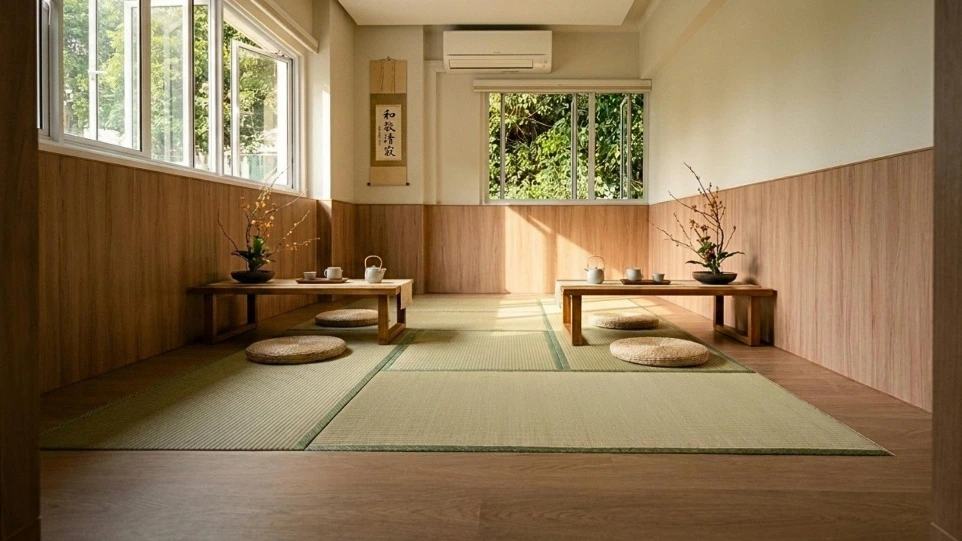
If you've typed "tatami bed" into Google and come away more confused than when you started, you're not alone. Between the Western futon foldout thing from someone's sharehouse in 2009, Instagram photos of beautiful low-profile Japanese-style rooms, and mattress companies using "tatami" as a loose aesthetic label, the term has become genuinely blurry.
So let's clear it up. What a tatami bed actually is. How it's built. And how it's genuinely different from the platform bed frame that's probably sitting in your room right now.
First, the term itself
"Tatami bed" isn't a Japanese term. In Japan, you don't buy a tatami bed, you set up a sleep system on a tatami floor. The phrase has emerged in Western markets to describe a floor-level sleeping setup that uses a tatami mat as its foundation. Think of it less as a piece of furniture and more as a philosophy of sleep: firm, low, natural, and minimal.
It has nothing to do with the fold-out Western futon sofa. That's a completely different thing.
What a tatami bed is actually made of
A traditional tatami bed setup has three layers, and each one matters.
The foundation: a tatami mat. This is the defining element. Tatami mats are hand-woven from Igusa rush grass, a plant that has been cultivated specifically for this purpose in Japan for nearly two millennia. The mat sits directly on your floor and forms the base of your entire sleep system. It's naturally firm, breathable, and subtly textured. It also regulates humidity by absorbing and releasing moisture, which keeps the surface underneath your mattress from trapping heat and condensation. In Australia, where summers are long and bedrooms can get warm, that's not a small detail.
The mattress: a shikibuton. Laid directly on the tatami mat, a shikibuton (also called a shiki futon) is a slim, foldable Japanese cotton mattress, typically 5 to 8 centimetres thick. It's filled with natural cotton and designed to provide firm spinal support without sinking. Because it folds completely, it stores away during the day. Your bedroom stops being a bedroom and becomes a room again. If you're in a Sydney apartment or a Melbourne terrace where every square metre counts, that matters.
The pillow: a makura. Traditional Japanese pillows, makura, are lower and firmer than Western pillows. When your body isn't sinking into a deep foam mattress, your head doesn't need to be propped as high to keep your spine aligned. The whole system is designed to work together.
Alternatively, if you want some extra cushioning while still keeping the low-profile, natural-material aesthetic, a Tatami 4-Fold Mattress can sit on top of the tatami mat instead of a shikibuton, slightly thicker, still foldable, still made from natural materials.
What a platform bed is
A platform bed is a raised bed frame, typically sitting 30 to 45 centimetres off the floor, with a flat top surface (the "platform") designed to support a mattress without a box spring. The frame is usually timber or metal. The mattress sits on top: often a pocket spring, latex, or memory foam mattress, anywhere from 20 to 35 centimetres thick.
Platform beds became popular as a cleaner alternative to traditional bed frames with bulky box springs, and they do look more minimal than their older counterparts. But the core assumptions haven't changed much: the bed is elevated, the mattress is deep and soft, and the setup is permanent. The room is a bedroom, all the time.
How they actually differ
The differences go deeper than just height.
The foundation material. A platform bed sits on timber or metal. A tatami bed sits on a living, natural material that breathes with you. Igusa grass naturally absorbs ambient humidity and releases it when conditions change, which is why tatami rooms in Japan stay remarkably fresh even in humid climates. A timber slat frame does not do this.
The mattress logic. Platform bed mattresses are typically soft and thick, designed to provide comfort through cushioning and contouring. A shikibuton works the other way: it's firm and thin, designed to support your spine in a neutral position rather than let it sink. For people who wake up stiff or with lower back tension after sleeping on a deep foam mattress, this shift can be significant. Many people report that after an adjustment period, they sleep on a tatami setup and feel more rested than they did before — not despite the firmer surface, but because of it.
The relationship with your room. A platform bed is fixed. It defines the room, divides the space, and stays there. A tatami sleep setup can be folded and stored, which transforms your room during the day, a concept the Japanese call ma, or meaningful negative space. If you've ever felt your bedroom was too dominated by your bed, this is why.
What it asks of you. A platform bed asks nothing. You change the sheets occasionally, and that's about it. A tatami setup has a daily routine: fold the shikibuton each morning, let the tatami breathe, air it out in sunlight when you can. It's a minor ritual, but one that many people find oddly grounding rather than inconvenient. You're taking care of the thing that takes care of your sleep.
The environmental footprint. Platform beds vary enormously in quality and materials. A tatami sleep system, natural igusa grass, cotton-filled shikibuton, and a timber-free setup is about as low-impact as bedding gets. For Australians who are increasingly mindful about what they bring into their homes and where it ends up, that matters.
Why this is resonating in Australia right now
Australia's design culture has been shifting steadily toward Japandi aesthetics — the Japanese-Scandinavian blend of natural materials, honest craftsmanship, and purposeful simplicity. That shift isn't purely visual. People are genuinely questioning whether more furniture, more height, more foam, more structure actually makes for better sleep.
There's also a practical argument that's specific to the Australian climate. In cities like Brisbane, Perth, and coastal New South Wales, warm months mean warm bedrooms. A sleep surface that naturally regulates humidity and allows airflow underneath your body isn't a luxury — it's the kind of thing you notice immediately. A tatami mat does this passively, without electronics or ventilation systems.
And then there's space. Australian cities have expensive real estate and a growing number of people living in apartments and compact homes. A sleep setup that folds away and gives you your room back every morning is genuinely useful, not just aesthetically interesting.
So, is a tatami bed right for you?
It's worth trying if you wake up stiff and have always assumed that's just what mornings feel like. If you're drawn to the idea of a room that doesn't revolve around your bed. If you want natural materials and a smaller footprint without sacrificing comfort. If you live in a warm part of Australia and your current mattress traps heat.
It's not the right choice if you have significant joint issues that require a very soft, highly cushioned surface — though many people with back concerns find the firmer setup helpful rather than harmful. The adjustment period is real: most people need two to four weeks before the firmer surface starts feeling normal rather than foreign.
The best way to think about it is this: a platform bed gives you comfort through accumulation — layers, height, foam, support structures. A tatami bed gives you comfort through simplicity — natural materials, floor level, and a surface designed to work with your body rather than compensate for it.
They're genuinely different approaches to sleep. And for a growing number of Australians, the tatami approach is the one that finally makes mornings feel like rest actually happened.
Ready to explore a tatami sleep setup? Start with our Tatami Mats and Shikibuton range, or read our guide to sleeping better with tatami to understand how the full system works.